
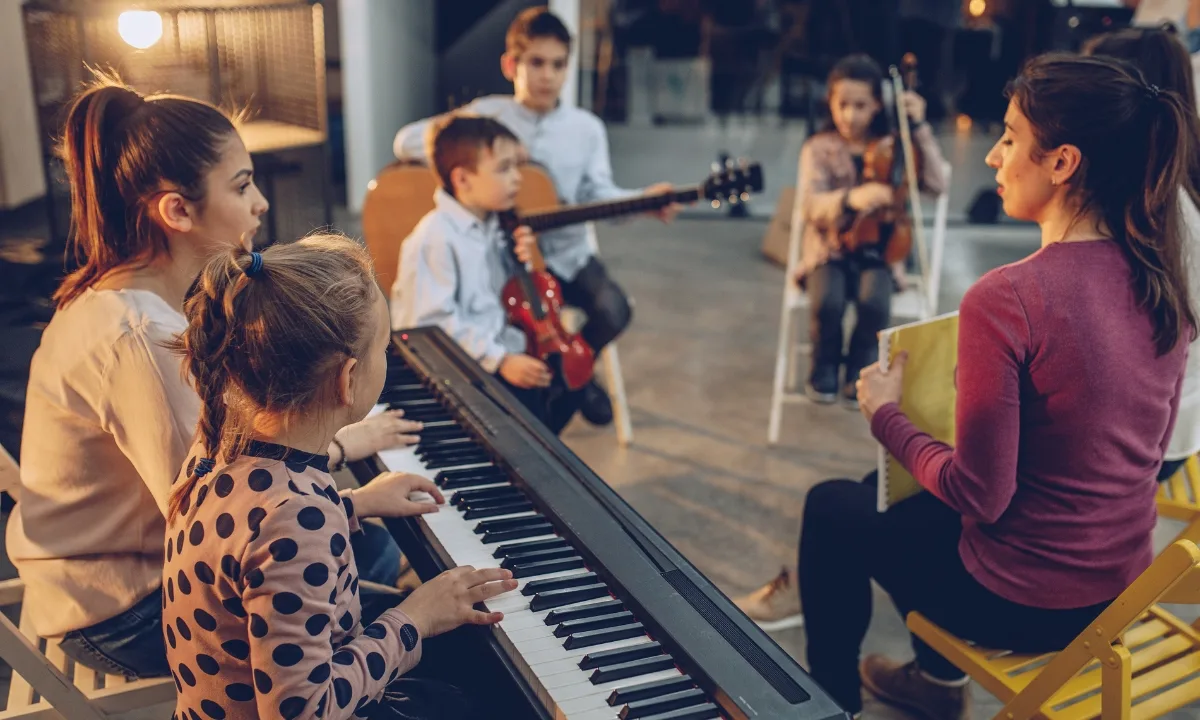

The Role of Music Classes in Developing Discipline in Kids
Learning an instrument may appear like an enjoyable creative outlet an outlet to express emotion and appreciate art yet its benefits far transcend this idea. Enrolling children in regular music classes can provide them with essential life skills such as discipline and focus that have an immense positive effect on academic performance, personal responsibility and future success.
This guide explores the relationship between musical practice, discipline and concentration. We will examine how learning an instrument helps children form strong work ethics as well as improving focus. If parents are questioning if music school education is right for their child this article provides clear insight into its many cognitive and emotional advantages.
The Cognitive and Emotional Benefits of Music
Before diving deeper into discipline and focus specifically, it’s helpful to gain an appreciation of how music affects a developing brain as a whole. Scientific studies have repeatedly proven the effectiveness of musical education for stimulating cognitive expansion.
As children learn an instrument, multiple areas of their brain become engaged simultaneously: reading musical notes and translating them to physical actions; listening for pitch and rhythm; coordinating movements to produce specific sounds and producing the correct noises this complex process strengthens neural pathways while yielding key benefits:
- Enhance Memory Capabilities: Musicians typically possess superior recall capabilities due to memorizing melodies, chord progressions and complex musical structures on an ongoing basis.
- Enhance Mathematical and Spatial Reasoning: Learning rhythm, scales and intervals is directly tied to mathematical concepts; consequently children become adept at intuitively grasping patterns and logic more readily than before.
- Enhance Language and Reading Skills: Teaching children how to decode musical notation and interpret phrasing can significantly strengthen their language processing and comprehension abilities, aiding in processing both spoken text as well as written material more efficiently.
Music education not only fosters cognitive benefits, but it can also build emotional intelligence in children. Playing music gives kids an outlet to release stress or express any hidden emotions – as well as building their self-confidence while group performances develop collaboration and empathy skills.
How Music Classes Build Lifelong Discipline
Discipline does not equate with punishment; rather, it refers to following through with long-term goals with consistency even when they can be difficult. Learning an instrument requires precisely this quality music center near me or you, like Opera Music & Arts Centre where their curriculum has been specifically created to develop this ability step-by-step.
Structure of Practice
Mastery of any musical piece takes time. A student must develop strategies to break a complex goal into manageable tasks in order to succeed at mastering this art form. Achieving musical excellence involves:
Engaging in regular scales and exercises to build technical proficiency.
Work through one difficult measure at a time until it becomes automatic.
Staying consistent in practice sessions even on days they don’t feel particularly motivated is important to ensuring they achieve results.
This process teaches children an essential lesson about discipline: success comes from small efforts compounded over time. They discover that dedication not talent alone is the cornerstone of achievement and that this mindset easily transfers over to other aspects of their lives, from homework completion and goal pursuit to maintaining health in general.
Delayed Gratification Is Worth Exploring
Music offers children an invaluable lesson in patience: perfecting an intricate piece takes hours upon hours of dedicated practice to achieve. Children learn that hard work will pay off later; whether that be onstage, classroom lessons or future careers.
Enhancing Concentration through Music
Focused effort has become more rare over time; music practice provides an ideal venue to strengthen this “focus muscle”.
As musicians play their instruments, their concentration must remain fully in the present. Their focus must be on reading notes, listening to pitch changes, keeping time and controlling physical movements; there should be little room for distraction; otherwise they risk making costly errors that result from losing focus and making errors that lead to mistakes being committed by both musicians and audience members alike.
Sustained Attention (H3)
Mastering music requires sustained concentration from beginning to end, something children may initially find hard. With regular practice and blocking out external distractions or internal chatter from interfering with task completion. Over time this heightened ability of concentration becomes invaluable in school environments allowing children to focus more efficiently while taking in information in class and studying without getting sidetracked easily.
Attention to Detail (H3)
Music requires immense precision in terms of detail. A single mis note, shift in rhythm or dynamics difference could alter its entirety; students learn how to listen critically and identify errors within themselves as they hone an ear for nuance resulting in more precise work that puts an emphasis on detail and precision.
Tips for Parents: Supporting Your Child’s Musical Journey (H2)
Are You Thinking about Enrolling Your Child in Music Classes in Sharjah? For their success, your help at home will be essential in nurturing their development: Here are a Few Strategies That Could Support Their Development
Establish an Ongoing Practice Routine:
Help your child set aside a specific practice time and place each day; consistency over length should be of utmost concern when starting young learners off on a musical journey.
Focus on Effort, Not Perfection:
Acknowledging all their hard work and efforts every day should not only be recognized, but praised as well. Recognize all that goes into practicing regularly.
- Be an Engaged Listener: Encourage your child to play for you. Show genuine curiosity for their progress and rejoice when small victories occur along their path to development.
- Finding an Excellent Teacher: When searching for instructors that excel at motivating and connecting with their students, consider a reputable music center like Opera Music & Arts Centre, which offers expert guidance in music classes in Sharjah.
- Make It Fun: Encourage your child to play music that they find enjoyable, attend concerts together and experiment with various genres in order to keep his/her passion for musical exploration alive.
Lay the Foundation for Future Success with Music Classes
Enrolling your child in music classes near me is an investment in their overall growth. Through practice and focus required to master an instrument, they’ll acquire essential lifelong skills: approaching challenges patiently; appreciating hard work’s rewards; and being able to focus intensely despite constant distractions.
Opera Music & Arts Centre’s mission is to foster an encouraging and encouraging learning environment where our students can develop musical talent while building character. Our experienced instructors guide kids along their musical journey while imparting discipline and focus that will serve them throughout life – not only when playing musical instruments.