
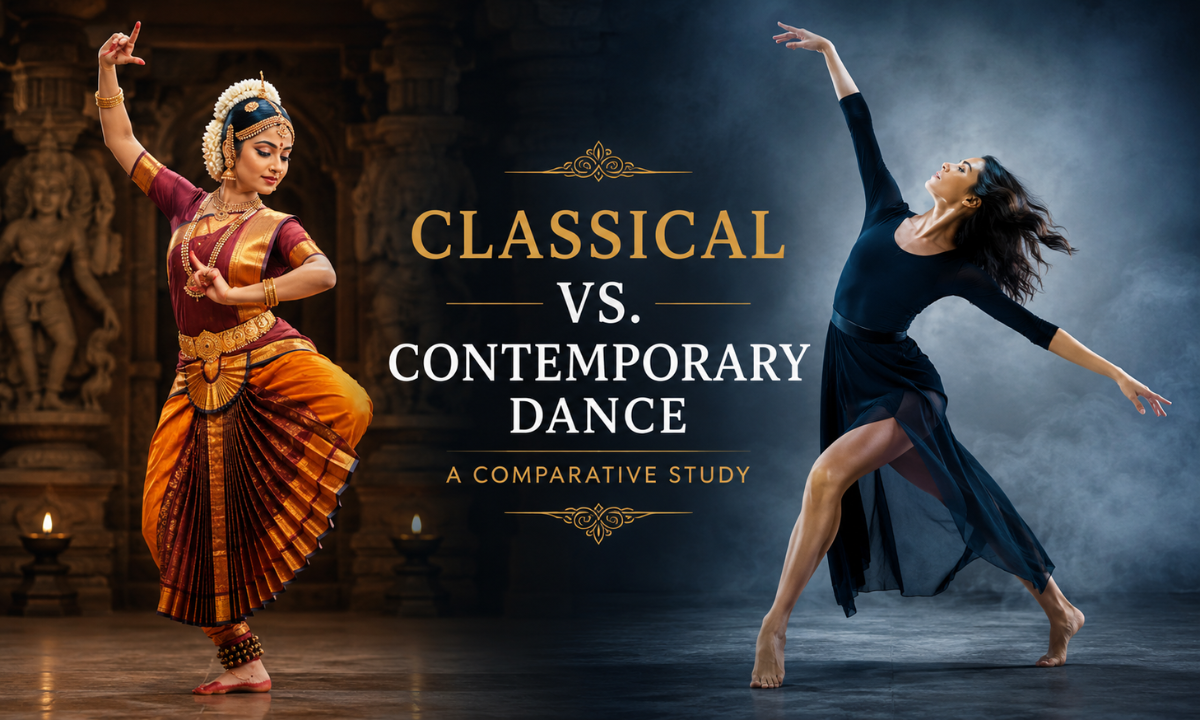
Dance is one of the oldest and most expressive forms of human communication. It transcends language barriers, allowing individuals to convey emotions, stories, traditions, and cultural values through movement. Across the world, dance has evolved into numerous styles, each reflecting the social, historical, and artistic influences of its time. Among these styles, classical dance and contemporary dance represent two distinct yet interconnected approaches to artistic expression. While classical dance is deeply rooted in tradition, discipline, and established techniques, contemporary dance embraces innovation, creativity, and personal interpretation.
The comparison between classical and contemporary dance provides valuable insights into how dance has evolved over time. Although they differ in their techniques, philosophies, and performance styles, both contribute significantly to the performing arts. This article explores the origins, characteristics, techniques, themes, costumes, music, training methods, and cultural significance of classical and contemporary dance, highlighting their similarities and differences.
Understanding Classical Dance
Classical dance refers to highly structured dance forms that have been developed over centuries and preserved through rigorous training and tradition. These dances are governed by established techniques, precise body movements, and strict rules. In many cultures, classical dance serves as a means of preserving history, mythology, and cultural identity.
In India, classical dance includes forms such as Bharatanatyam, Kathak, Odissi, Kuchipudi, Manipuri, Kathakali, Mohiniyattam, Sattriya, and Chhau. Each style has unique movements, costumes, and storytelling traditions but shares a strong emphasis on discipline, rhythm, and expression.
Similarly, ballet is considered the classical dance form of Western culture. It follows codified techniques developed during the Renaissance and refined over centuries.
Characteristics of Classical Dance
Some defining features of classical dance include:
- Structured and codified movements.
- Strong emphasis on posture, balance, and precision.
- Use of symbolic gestures and facial expressions.
- Storytelling based on mythology, religion, or historical events.
- Years of disciplined training under experienced instructors.
- Traditional costumes, ornaments, and makeup.
- Performance accompanied by classical music.
Classical dance emphasizes perfection, discipline, and respect for tradition, making it one of the most demanding performing arts.
Understanding Contemporary Dance
Contemporary dance emerged during the twentieth century as a reaction against the rigid structures of classical ballet. It combines elements from ballet, modern dance, jazz, improvisation, and experimental movement to create a highly expressive and flexible dance style.
Unlike classical dance, contemporary dance encourages dancers to explore their individuality and emotions. Rather than following fixed rules, dancers experiment with body movements, gravity, space, and rhythm to communicate ideas and feelings.
Today, contemporary dance is widely performed in theatres, festivals, educational institutions, and international competitions. It continues to evolve by incorporating influences from different cultures and artistic disciplines.
Characteristics of Contemporary Dance
The major characteristics include:
- Freedom of movement and creativity.
- Fluid, natural body movements.
- Use of improvisation and experimentation.
- Emotional and abstract storytelling.
- Combination of multiple dance techniques.
- Flexible costumes depending on the performance.
- Music ranging from classical compositions to electronic sounds or even silence.
Contemporary dance values originality and encourages dancers to develop their own artistic voice.
Comparison Between Classical and Contemporary Dance
Although both dance forms are artistic expressions, they differ in several important aspects.
1. Origin and History
Classical dance has ancient origins and is rooted in religious, cultural, and historical traditions. Many classical dance forms have existed for hundreds or even thousands of years.
Contemporary dance is relatively modern, developing during the twentieth century as artists sought greater freedom from traditional dance rules.
2. Technique
Classical dance follows precise techniques that must be mastered through years of practice. Every movement has a defined purpose and execution.
Contemporary dance allows flexibility and encourages dancers to modify movements according to artistic interpretation. Innovation is valued more than strict adherence to technique.
3. Purpose
The primary purpose of classical dance is to preserve cultural heritage, narrate stories, and maintain traditional artistic standards.
Contemporary dance focuses on expressing emotions, exploring social issues, and presenting creative interpretations of modern life.
4. Storytelling
Classical dance often tells stories from mythology, religion, folklore, or historical events using symbolic gestures and expressions.
Contemporary dance may present abstract ideas, personal experiences, psychological emotions, or social commentary without following a linear narrative.
5. Music
Classical dance performances typically use traditional or classical music that follows established rhythmic patterns.
Contemporary dance uses diverse musical styles, including classical, jazz, electronic, pop, world music, or complete silence.
6. Costume and Appearance
Classical dancers wear elaborate costumes, jewelry, makeup, and accessories that represent cultural traditions and characters.
Contemporary dancers generally wear simple, comfortable clothing that allows unrestricted movement. The costume is often designed to support the artistic concept rather than tradition.
7. Training
Classical dance requires long-term, systematic training under qualified teachers. Students spend years mastering posture, footwork, gestures, rhythm, and expression.
Contemporary dance also requires technical training but encourages creativity, improvisation, and experimentation alongside technical skills.
Similarities Between Classical and Contemporary Dance
Despite their differences, both dance forms share several important similarities.
Artistic Expression
Both styles allow dancers to communicate emotions, ideas, and stories through movement. Dance remains a powerful non-verbal language regardless of style.
Physical Fitness
Both classical and contemporary dance improve flexibility, strength, endurance, balance, coordination, and overall physical health.
Discipline and Dedication
Professional dancers in both fields require years of consistent practice, commitment, and perseverance to achieve excellence.
Creativity
Although creativity is more prominent in contemporary dance, classical dancers also demonstrate creativity through expressive storytelling, interpretation of characters, and emotional performance.
Audience Engagement
Both forms aim to captivate audiences through beautiful choreography, emotional expression, musicality, and visual presentation.
Advantages of Classical Dance
Classical dance offers several benefits:
- Preserves cultural heritage and traditions.
- Develops discipline and concentration.
- Improves posture, flexibility, and coordination.
- Strengthens memory through complex choreography.
- Enhances emotional expression through facial gestures and storytelling.
- Promotes appreciation of music, literature, and history.
Advantages of Contemporary Dance
Contemporary dance also provides numerous advantages:
- Encourages creativity and originality.
- Allows freedom of personal expression.
- Adapts easily to modern themes and social issues.
- Improves body awareness and flexibility.
- Promotes innovation in choreography.
- Provides opportunities for collaboration across different art forms.
Challenges Faced by Both Dance Forms
Despite their popularity, both classical and contemporary dance face challenges in today’s rapidly changing world.
Classical dance struggles to attract younger audiences who may prefer modern entertainment. Maintaining authenticity while adapting to changing tastes remains a significant concern.
Contemporary dance faces criticism for lacking standardized techniques, making evaluation more subjective. Because it constantly evolves, preserving its identity can also be challenging.
Additionally, both dance forms require extensive physical training, financial investment, and dedication, making professional careers highly competitive.
The Future of Dance
The future of dance lies not in choosing one style over another but in recognizing the value of both traditions and innovation. Many choreographers now create fusion performances that combine classical techniques with contemporary movement, resulting in fresh and engaging artistic experiences.
Technology is also transforming dance through digital performances, motion capture, virtual reality, and online learning platforms. These innovations allow dancers to reach global audiences while preserving traditional art forms.
Educational institutions increasingly recognize the importance of teaching both classical and contemporary dance, enabling students to develop strong technical foundations alongside creative thinking.
Conclusion
Classical and contemporary dance represent two complementary dimensions of the performing arts. Classical dance preserves centuries of cultural heritage through disciplined technique, storytelling, and tradition, while contemporary dance reflects the evolving nature of society through creativity, experimentation, and emotional freedom.
Curious about dance classes? Explore our dance classes at Opera Music & Arts Centre.