Music + Mental Math is a pairing most parents don’t think about until they watch it happen in front of them. A child counts out loud while clapping to a beat, or subdivides a rhythm without realizing they’re doing division. It’s one of the reasons so many parents searching for music classes in Sharjah are surprised to learn that a piano lesson or a drumming session can do just as much for a child’s number sense as it does for their ear.
Rhythm, at its core, is math you can hear. Every beat, rest, and time signature is built on ratios and fractions. When a child learns to keep a steady 4/4 beat, or counts “one-and-two-and” on a keyboard, they’re quietly practicing division, sequencing, and pattern recognition — the same skills that show up again in the math classroom.
Rhythm and Mathematics: A Natural Pair
Music notation is, quite literally, a system of fractions. A whole note splits into two half notes, four quarter notes, or eight eighth notes, and a child reading rhythm is reading proportional relationships long before they ever see a fraction on a worksheet.
Notes as Fractions
When a young pianist learns that two quarter notes equal one half note, they’re absorbing the same logic behind splitting a pizza into equal slices. The instrument becomes a hands-on fraction lesson that doesn’t feel like homework.
Beats as Sequences
Counting a bar of music — “1, 2, 3, 4” — and repeating that pattern across a whole piece builds the same mental muscle used in recognizing number sequences and patterns in early mathematics.
How the Brain Handles Rhythm and Numbers
Rhythm and number processing both rely on the brain’s ability to track timing, order, and structure. Researchers at the National Institutes of Health have noted that rhythm exposure during childhood is linked to development in brain regions responsible for attention and executive function — the same mental tools children lean on for problem-solving in math (NIH/NCCIH).
A peer-reviewed review in Frontiers in Human Neuroscience points to rhythmic entrainment — the brain’s process of syncing to a steady beat — as a possible mechanism supporting the development of executive function and attention in children learning music (Frontiers in Neuroscience).
Scientific Benefits Behind Music + Mental Math
None of this means a few piano lessons will turn a child into a math prodigy overnight. What the research does support is more modest, and frankly more useful: consistent rhythm practice strengthens attention, working memory, and sequencing — the underlying skills that make math easier to grasp, not a shortcut around learning it.
Working Memory in Action
Holding a rhythm pattern in your head while your hands play something different — think patting your knee on the beat while singing a different melody — is a daily working-memory workout.
Music and Pattern Recognition
Mathematics is, at its heart, the study of patterns, and so is music. A child who can predict what comes next in a melody is using the same forward-thinking logic needed to complete a number sequence or spot a repeating pattern in a math problem — the pattern-spotting habit at the center of Music + Mental Math.
This is part of why organizations like the National Association for Music Education continue to advocate for music as a core part of a well-rounded education, alongside subjects like math and reading (NAfME).
Rhythm, Memory and Focus
Learning a piece of music by heart requires chunking information into manageable sections — a phrase, a verse, a chorus. Children unconsciously apply this same chunking strategy to multi-step math problems, breaking a big task into smaller, solvable steps.
That habit of breaking things down carries over well beyond the practice room, helping children approach homework and tests with a calmer, more organized mindset.
Why Piano Strengthens Math Thinking
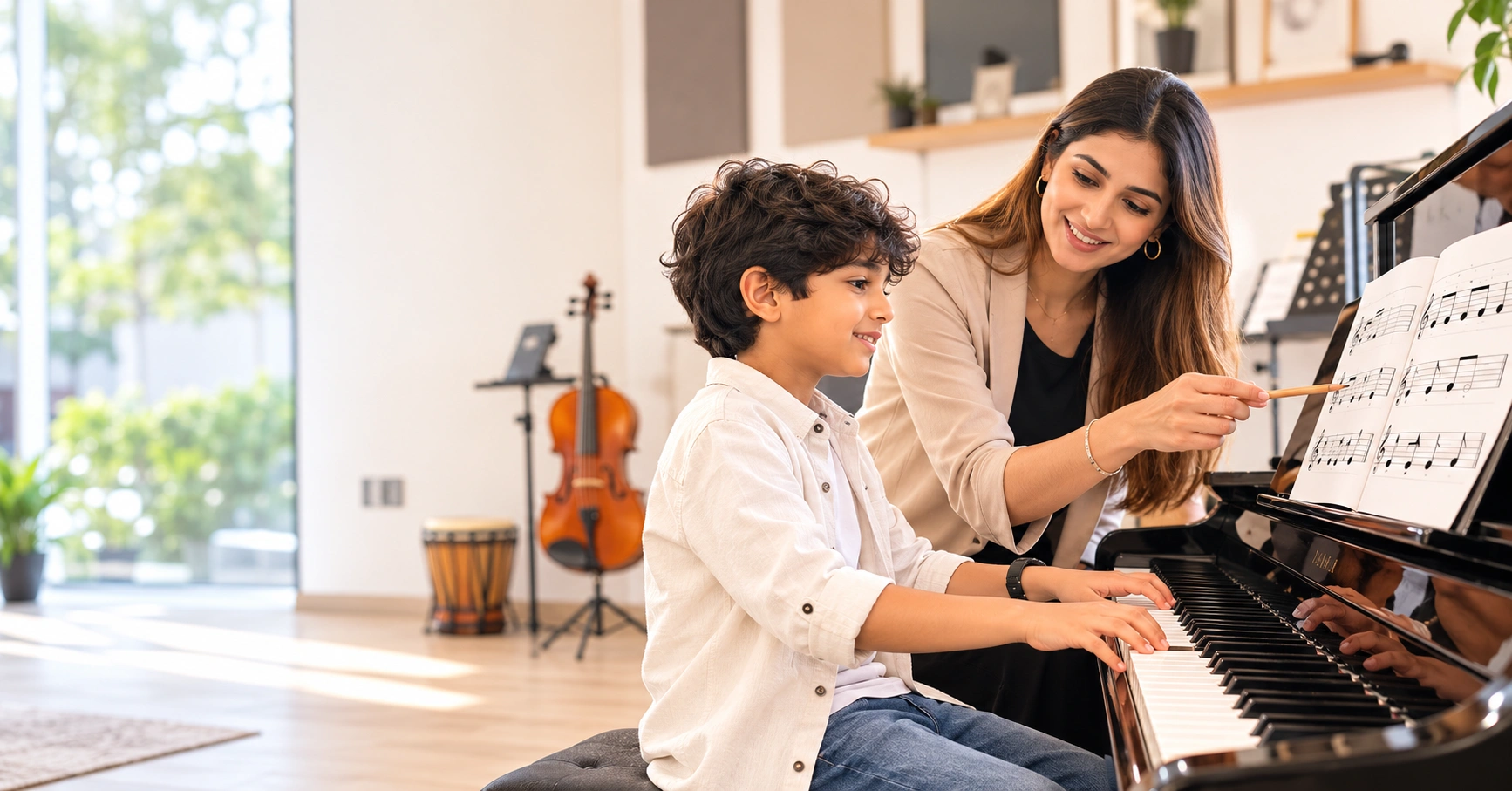
Piano is often the instrument parents choose first, and there’s a reason it pairs so well with math. Two hands play different rhythms simultaneously, both hands read different pitches at once, and every new piece introduces a fresh pattern to decode.
Beginners Learn Counting Systems
Even a five-year-old at the keyboard is learning to count in twos, threes, and fours — the earliest building blocks of multiplication.
Advanced Students Learn Proportional Timing
Older students working through more complex rhythms are essentially solving proportion problems every time they play, which is one reason piano classes in Sharjah at Opera remain some of our most requested lessons.
Benefits by Age Group
The connection between rhythm and number sense looks different depending on how old a child is, but it starts early and keeps building.
Preschool Children
For toddlers and preschoolers, rhythm shows up as clapping games, marching to a beat, or tapping along to a nursery rhyme — playful activities that build an early sense of sequence and order, the very foundation number sense is built on.
School-Age Children
By the time children reach primary school, structured rhythm training through an instrument adds a layer of discipline to that early foundation. Reading sheet music while keeping time trains the brain to process two things at once, a skill that transfers well to multi-step and word problems.
Key Benefits of Rhythm Training
- Strengthens working memory and short-term recall
- Builds pattern recognition used in early algebra and sequencing
- Improves focus and sustained attention span
- Introduces fractions naturally through note values
- Encourages sequential, step-by-step thinking
- Supports listening skills that carry over into instructions and word problems
- Builds confidence through mastering small, achievable patterns
- Develops discipline through consistent daily practice
Rhythm Activities to Try at Home
You don’t need an instrument at home to reinforce what your child is learning in class. A few minutes a day is enough to keep the connection between rhythm and numbers alive, and these simple, screen-free activities work well for any age.
Simple Music + Mental Math Activities for Parents
- Clap a short rhythm and ask your child to clap it back
- Count out loud together while tapping a steady beat
- Use a favorite song to practice skip-counting by twos or threes
- Split a snack into halves and quarters while humming a matching rhythm
- Play “echo clapping” games during car rides or bath time
- March to a beat while counting steps aloud
- Take turns inventing a rhythm pattern for the other person to copy
Choosing the Right Music Academy
Not every music program is structured to build these skills intentionally. A strong curriculum, small class sizes, and instructors trained to explain the “why” behind rhythm — not just the “how” — make the difference between a child who memorizes a song and a child who genuinely understands the structure behind it.
This is one reason families researching a Sharjah music academy tend to ask detailed questions about class size, teacher qualifications, and curriculum before enrolling — and rightly so.
Why Choose Opera Music & Arts Centre
As a Trinity College London registered exam centre, Opera Music and Arts Centre Sharjah builds every lesson around structured, progressive learning — from our piano classes to our broader music classes. Our instructors don’t just teach students to play a piece; they teach them to understand the counting, timing, and patterns underneath it.
Whether your child is just starting with our Trinity-certified programs or exploring our full range of courses, the goal is the same: build real skills that carry over into the classroom and beyond.
Final Thoughts
Rhythm training won’t replace a math tutor, and no serious music educator would claim otherwise. But the overlap behind Music + Mental Math is real — counting, sequencing, patterns, and working memory sit at the heart of both disciplines, and for families exploring music classes in Sharjah, that overlap is one more reason a music education is rarely just about music.
If you’d like to see how a structured, Trinity-certified program can support your child’s development, get in touch with Opera Music & Arts Centre to book a trial class.
Curious about music classes? Explore our music classes at Opera Music & Arts Centre.