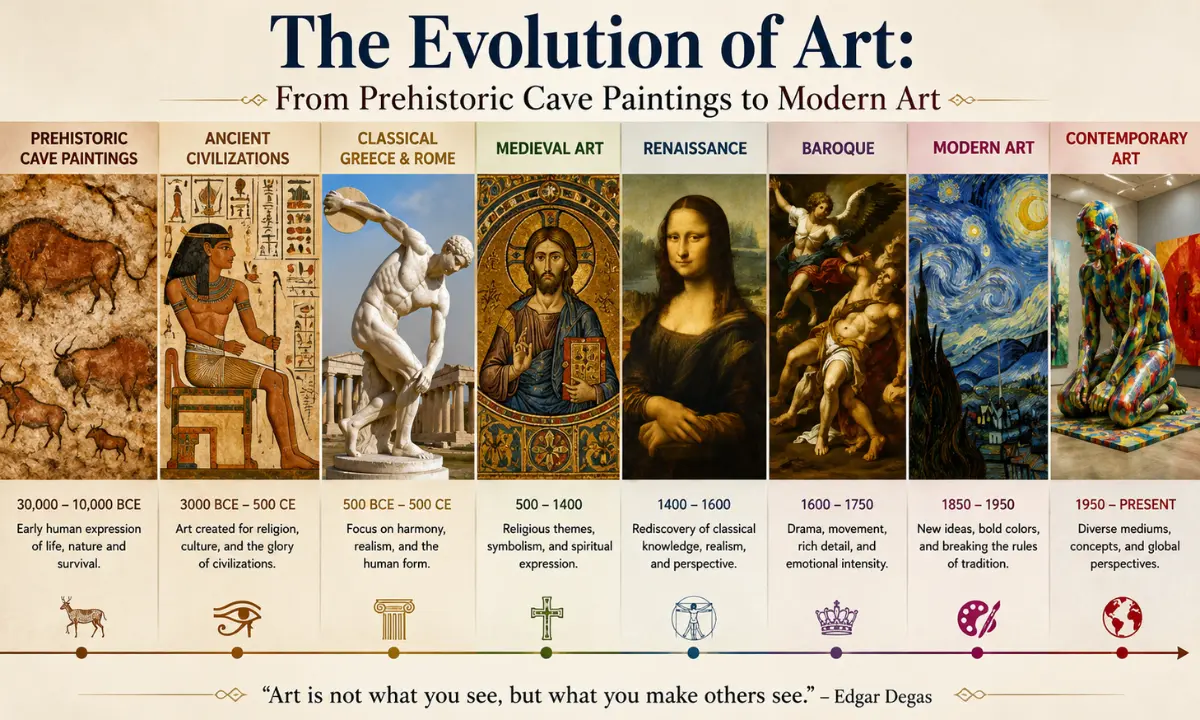
Art is one of humanity’s oldest and most powerful forms of expression. Long before written language existed, people used images, symbols, colours, and forms to communicate ideas, tell stories, and record their experiences. From the mysterious cave paintings of prehistoric societies to the bold experiments of modern artists, the history of art reflects the evolution of human civilisation itself.
At Opera Music and Art Centre, we believe that understanding the history of art enriches our appreciation of creativity in all its forms. By exploring how artistic expression has transformed across thousands of years, we gain insight into the cultures, beliefs, and innovations that shaped our world.
The Birth of Art: Prehistoric Cave Paintings
The earliest known artworks date back tens of thousands of years. Prehistoric humans created paintings and engravings on cave walls using natural pigments made from minerals, charcoal, and clay.
Some of the most famous examples can be found in the Lascaux Caves in France and the Altamira Cave in Spain. These remarkable paintings depict animals such as horses, bison, deer, and mammoths, often rendered with surprising detail and movement.
While historians continue to debate their exact purpose, these artworks likely served several functions:
- Recording important events
- Communicating hunting knowledge
- Expressing spiritual beliefs
- Celebrating community traditions
These early creations demonstrate that the desire to create and communicate visually is deeply rooted in human nature.
Ancient Civilizations and Symbolic Art
As societies became more organized, art evolved beyond cave walls and became an essential part of religion, governance, and daily life.
Egyptian Art
Ancient Egyptian art is among the most recognizable in history. Characterized by strict rules, symbolic representations, and monumental architecture, Egyptian artists created works designed to honor gods and ensure a successful afterlife.
Paintings, sculptures, and hieroglyphics adorned temples and tombs, serving both decorative and spiritual purposes.
Mesopotamian Art
In Mesopotamia, often called the “Cradle of Civilization,” artists produced intricate relief carvings, statues, and decorative objects that celebrated kings, military victories, and religious beliefs.
Greek Art
The Greeks introduced a revolutionary focus on realism, balance, and human beauty. Sculptors studied anatomy and proportion, creating lifelike representations of the human form that continue to influence artists today.
Their emphasis on harmony and ideal beauty established artistic principles that would shape Western art for centuries.
Roman Art
Building upon Greek traditions, Roman artists excelled in portraiture, mosaics, and architectural innovation. They documented everyday life, political achievements, and historical events through visual storytelling.
The Spiritual Focus of Medieval Art
Following the fall of the Roman Empire, European art entered the Medieval period, spanning roughly from the 5th to the 15th century.
During this era, religion became the dominant influence on artistic expression. Most artworks were commissioned by the Church and designed to educate people about religious teachings.
Characteristics of Medieval art include:
- Symbolic rather than realistic representation
- Gold backgrounds and decorative elements
- Religious themes and biblical narratives
- Illuminated manuscripts and stained-glass windows
Artists were less concerned with realism and more focused on conveying spiritual meaning. Cathedrals became centers of artistic achievement, featuring breathtaking architecture, sculptures, and colorful glasswork.
While often viewed as less realistic than classical art, Medieval art played a crucial role in preserving knowledge and cultural identity during a transformative period of history.
The Renaissance: Rebirth of Creativity and Knowledge
The Renaissance, beginning in 14th-century Italy, marked one of the most significant turning points in art history.
Inspired by the rediscovery of classical Greek and Roman ideas, Renaissance artists embraced humanism, scientific observation, and individual creativity.
Key innovations included:
- Linear perspective
- Realistic anatomy
- Natural lighting and shadow
- Emotional expression
- Scientific study of the human body
Artists such as Leonardo da Vinci, Michelangelo, and Raphael elevated art to new heights of technical mastery and intellectual sophistication.
Leonardo’s works demonstrated extraordinary understanding of science and observation, while Michelangelo’s sculptures revealed unmatched skill in depicting the human form.
The Renaissance transformed the role of the artist from anonymous craftsman to celebrated creator and thinker.
The Drama and Emotion of the Baroque Period
The 17th century introduced the Baroque movement, characterized by grandeur, drama, and emotional intensity.
Artists sought to create powerful visual experiences through:
- Dynamic compositions
- Strong contrasts of light and shadow
- Rich colors
- Movement and energy
- Emotional storytelling
Baroque art often reflected the political and religious tensions of the time. Churches, monarchs, and wealthy patrons commissioned large-scale works designed to inspire awe and admiration.
This period demonstrated how art could influence emotions and shape public perception, laying foundations for modern visual communication.
Enlightenment and Neoclassicism
As Europe entered the Age of Enlightenment, artists increasingly emphasized reason, order, and intellectual values.
Neoclassical artists looked back to ancient Greece and Rome for inspiration. Their works featured:
- Balanced compositions
- Historical themes
- Moral lessons
- Clear structure and precision
Art became a vehicle for expressing ideals such as civic responsibility, patriotism, and rational thought.
This movement reflected society’s growing interest in science, philosophy, and political reform.
Romanticism: Celebrating Emotion and Imagination
In reaction to strict rationalism, the Romantic movement emerged during the late 18th and early 19th centuries.
Romantic artists prioritized:
- Emotion
- Individual experience
- Nature
- Imagination
- Sublime beauty
Instead of focusing on perfect order, they explored dramatic landscapes, powerful feelings, and personal expression.
Romanticism encouraged artists to communicate inner experiences, helping pave the way for many modern artistic movements.
Realism and Impressionism: Capturing Everyday Life
The Industrial Revolution brought significant social and technological changes. Artists began to focus on ordinary people and contemporary life.
Realism
Realist artists rejected idealized subjects and depicted everyday experiences with honesty and accuracy.
Their work highlighted:
- Working-class life
- Social issues
- Urban development
- Contemporary realities
Impressionism
Later in the 19th century, Impressionist artists revolutionized painting by capturing fleeting moments of light and atmosphere.
Instead of carefully detailed studio paintings, they often worked outdoors and used:
- Visible brushstrokes
- Vibrant colors
- Natural lighting
- Everyday subjects
Impressionism challenged traditional artistic conventions and opened the door to greater experimentation.
The Rise of Modern Art
The late 19th and early 20th centuries witnessed an explosion of artistic innovation known collectively as Modern Art.
Artists began questioning traditional techniques and exploring new ways of seeing the world.
Major modern movements included:
Expressionism
Focused on emotional intensity rather than objective reality.
Cubism
Broke objects into geometric forms and multiple viewpoints.
Surrealism
Explored dreams, imagination, and the subconscious mind.
Abstract Art
Moved away from realistic representation entirely, emphasizing shapes, colors, and visual relationships.
Modern artists challenged audiences to think differently about the purpose and meaning of art.
Contemporary Art in the Digital Age
Today, art continues to evolve alongside technology and global culture.
Contemporary artists work across a wide range of mediums, including:
- Painting
- Sculpture
- Photography
- Video installations
- Digital art
- Virtual reality
- Artificial intelligence-generated art
The internet has transformed how art is created, shared, and experienced. Artists can now reach global audiences instantly, while viewers can explore collections from museums around the world without leaving home.
Contemporary art often addresses important themes such as:
- Identity
- Diversity
- Climate change
- Technology
- Social justice
- Globalization
The boundaries between artistic disciplines have become increasingly fluid, encouraging collaboration across music, visual arts, performance, and digital media.
The Enduring Connection Between Art and Humanity
Despite dramatic changes in style, technique, and technology, the fundamental purpose of art remains remarkably consistent. Throughout history, art has helped people express emotions, preserve memories, communicate ideas, and explore the complexities of human existence.
From prehistoric cave painters documenting their world to contemporary artists experimenting with digital tools, every generation has contributed to the ongoing story of creativity.
At Opera Music and Art Centre, we celebrate this rich artistic legacy by inspiring students and art enthusiasts to explore, create, and appreciate the many forms of artistic expression. Understanding the evolution of art not only deepens our knowledge of history but also encourages us to become active participants in the creative future.